
Quantitative developer, algorithmic trading systems, NSE equities and derivatives
Yash Arya, quantitative developer.
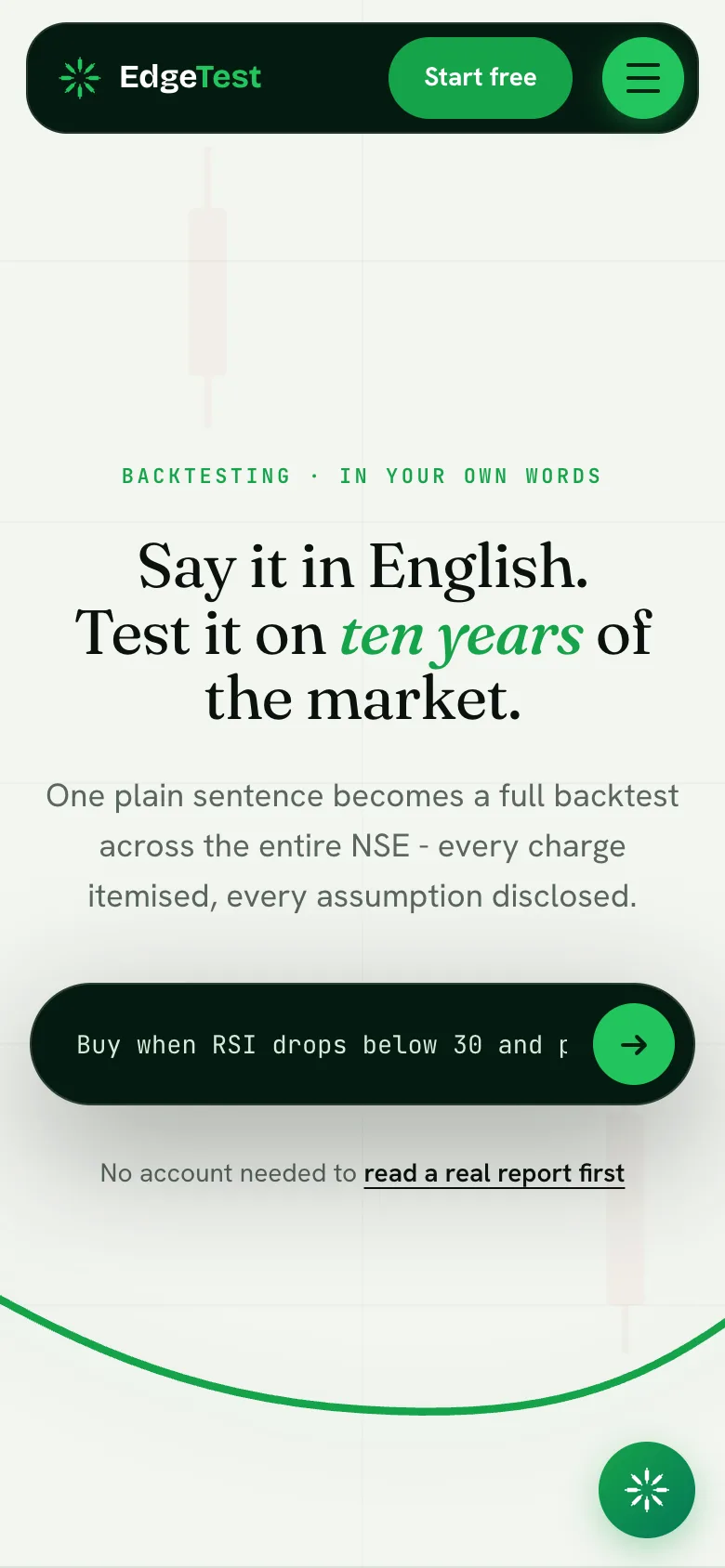
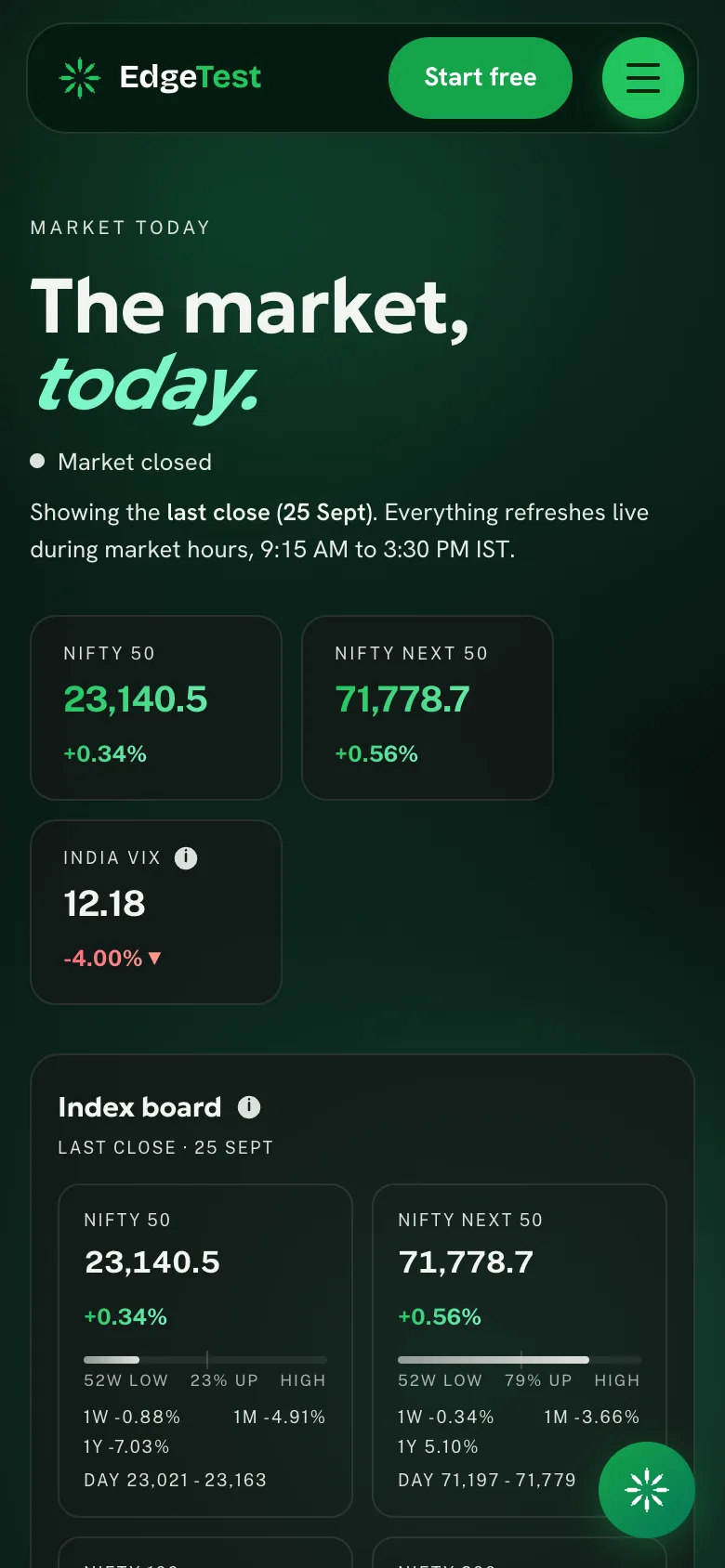
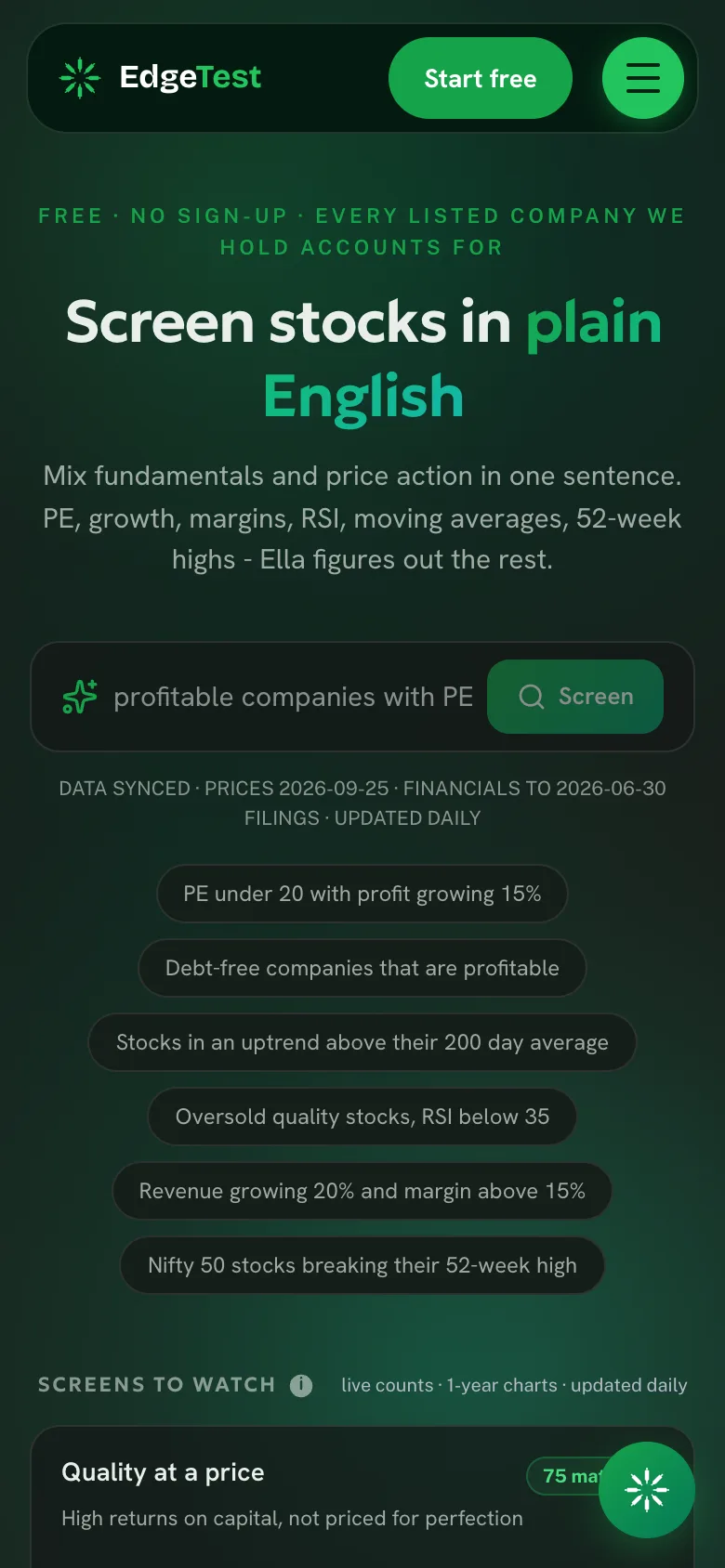
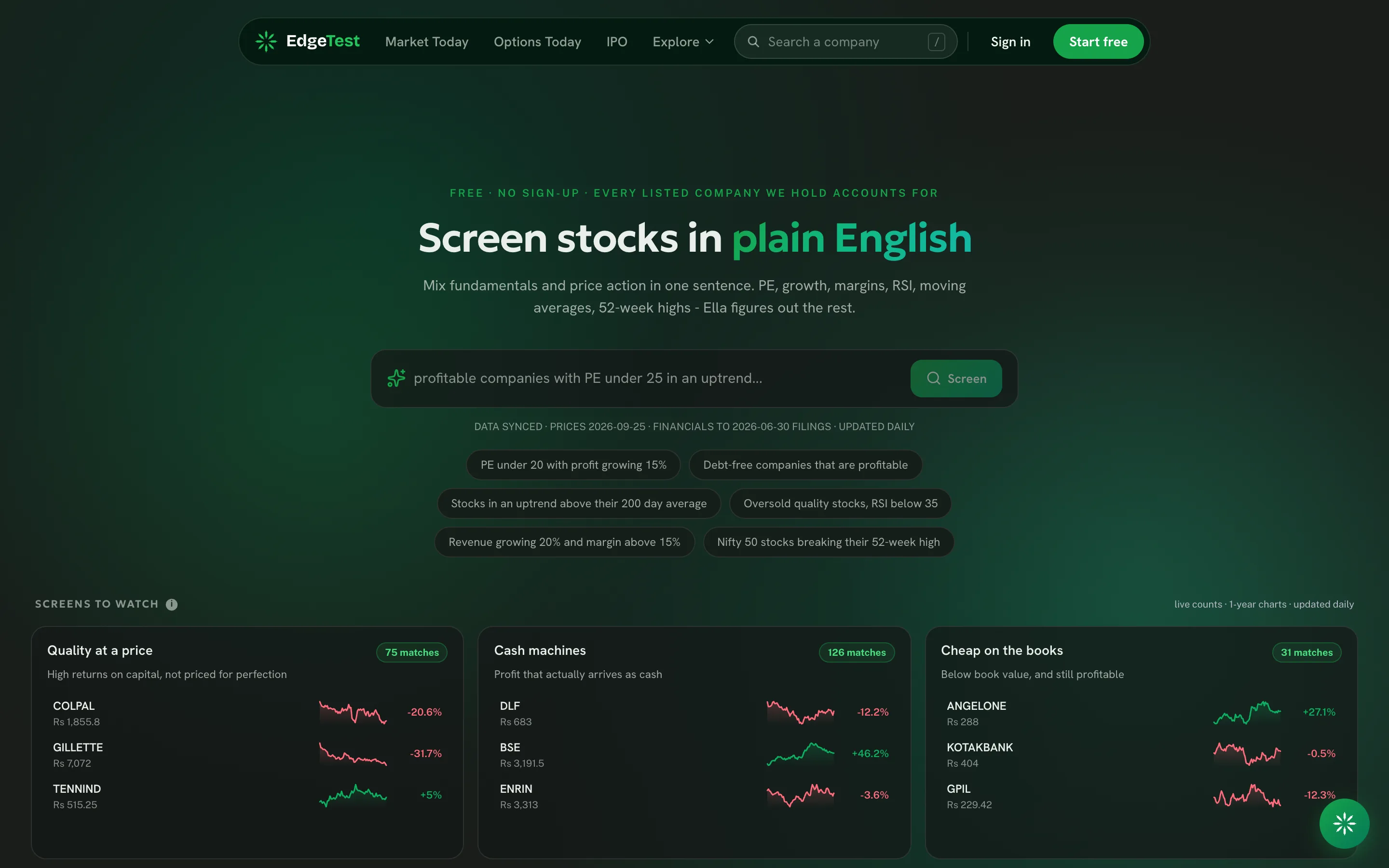
I'm Yash. I build and run EdgeTest, a backtesting, market-data and paper-trading platform for NSE equities and index options, from the data pipeline and cost models to the engine, API and UI.
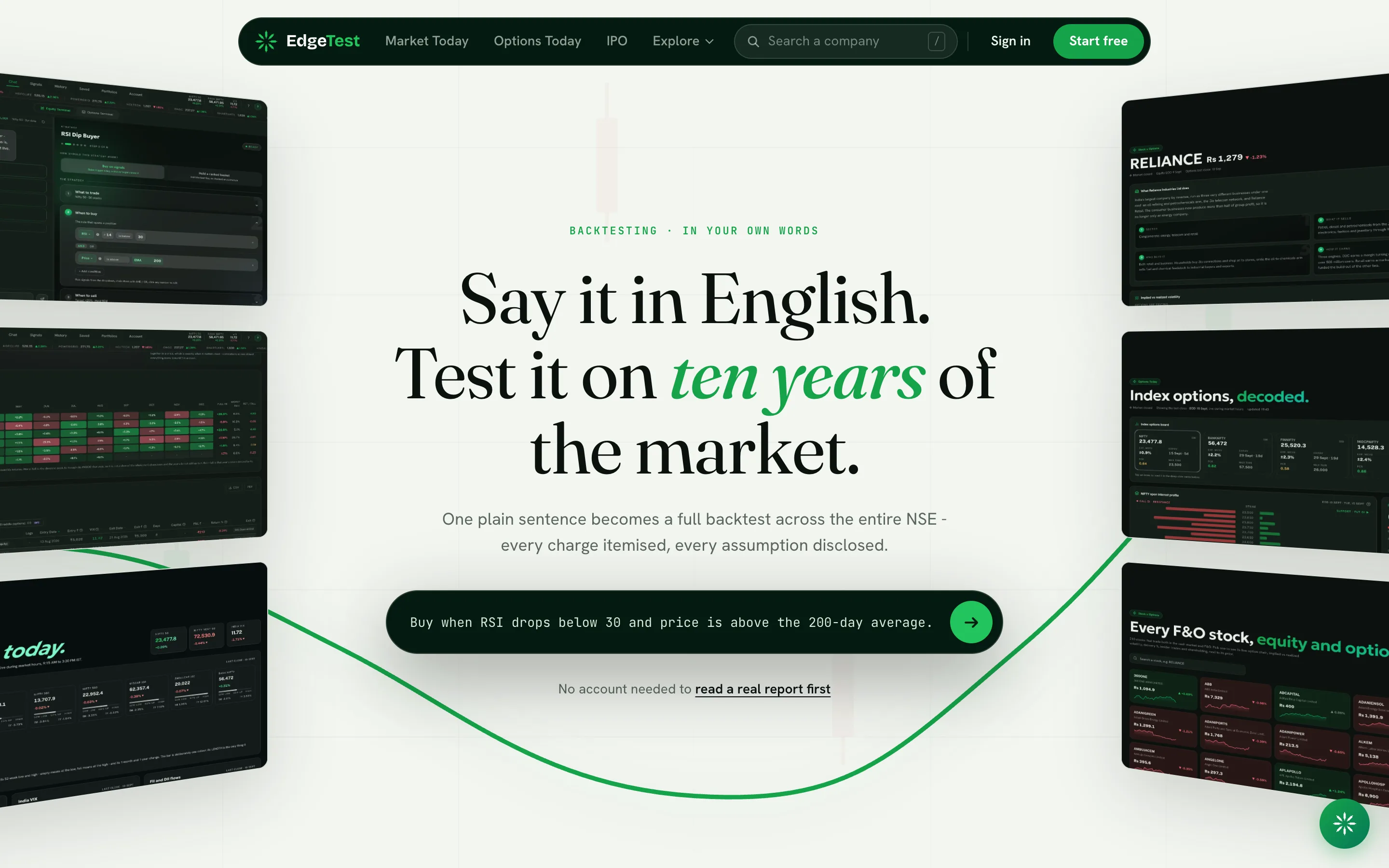
One platform, from data pipeline to user interface.
I build and run EdgeTest, a backtesting, market-data and paper-trading platform for NSE equities and index options, from data pipeline and cost models to engine, API and UI. My focus is backtests a trader can trust: costs checked against a real contract note, margin against the broker's calculator, runs reproducible byte for byte, strategies tested on sealed out-of-sample data.
B.Tech, Computer Software Engineering (2024); earlier 3 years in performance marketing.
30.6M
F&O rows, daily, 2016 to Oct 2026
195M
1-minute bars (equity + options)
3,519
listed companies, 376 ETFs/REITs/InvITs
62 · 24
indicators · options templates, 11 strike modes
~10 s
10-yr, 497-stock backtest end to end
1,700+
tests, mutation-checked
From a sentence to a report you can trust
- Step 1: Say it
- Step 2: Run it
- Step 3: Cost it
- Step 4: Prove it
Plain-English strategy in, NSE backtest out. An LLM parser with tool-use validation turns the sentence into rules the engine can run.
A real cash-and-holdings portfolio with next-open fills, gap-through stops and trailing stops. On the options side, checked against 16 strategies' published payoff identities (16/16).
Costs and margin measured, not assumed. Date-aware cost tables reproduce a real broker contract note to the paisa. The margin gate was 11 to 15x too light against the broker's SPAN calculator; I rebuilt it to within ~7%.
Every report carries drawdown anatomy, exit mix, a luck test of 10,000 reshuffles and a run fingerprint that makes any result replayable. 1,700+ tests, mutation-checked.
You type
Buy when RSI drops below 301 and price is above the 200-day average2. Sell at +25%3, stop at -8%4.
- 1Entry
- 2Filter
- 3Target
- 4Stop
EdgeTest turns this into a 10-year backtest across the NSE.
Equity engine
- Next-open fills
- Gap-through stops
- Trailing stops
- SIP / lump sum (XIRR)
- 62 indicators
- 36 point-in-time fundamentals
- 65 universes + 22 industries
Options engine, 10 years of exchange data
- 24 templates
- Up to 10 custom legs
- 11 strike modes
- Margin-gated entries
- 16 / 16 payoff identities
Charges checked against a real broker contract note
- BrokerageRs 480.00
- STTRs 86.00
- Exchange chargesRs 40.62
- SEBI feesRs 0.11
- Stamp dutyRs 2.00
- GSTRs 93.73
Margin gate, before
11 to 15x too light
against the broker's SPAN calculator
After the rebuild
within ~7%
of the same calculator
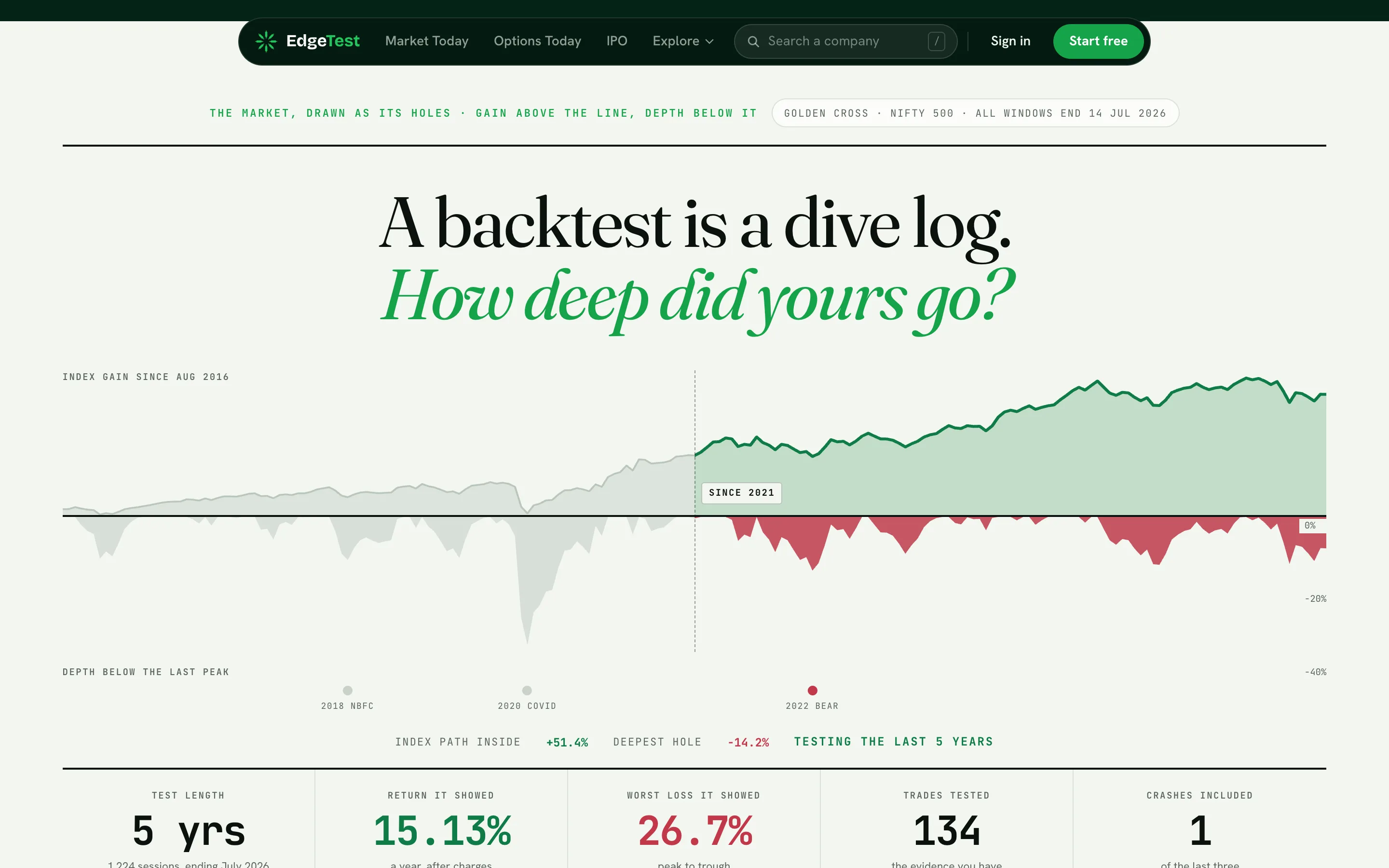
- Drawdown anatomy
- Exit mix
- Luck test: 10,000 reshuffles
- Run fingerprint
From a sentence to a report you can trust
1
Say it
Plain-English strategy in, NSE backtest out. An LLM parser with tool-use validation turns the sentence into rules the engine can run.
You type
Buy when RSI drops below 301 and price is above the 200-day average2. Sell at +25%3, stop at -8%4.
- 1Entry
- 2Filter
- 3Target
- 4Stop
EdgeTest turns this into a 10-year backtest across the NSE.
2
Run it
A real cash-and-holdings portfolio with next-open fills, gap-through stops and trailing stops. On the options side, checked against 16 strategies' published payoff identities (16/16).
Equity engine
- Next-open fills
- Gap-through stops
- Trailing stops
- SIP / lump sum (XIRR)
- 62 indicators
- 36 point-in-time fundamentals
- 65 universes + 22 industries
Options engine, 10 years of exchange data
- 24 templates
- Up to 10 custom legs
- 11 strike modes
- Margin-gated entries
- 16 / 16 payoff identities
3
Cost it
Costs and margin measured, not assumed. Date-aware cost tables reproduce a real broker contract note to the paisa. The margin gate was 11 to 15x too light against the broker's SPAN calculator; I rebuilt it to within ~7%.
Charges checked against a real broker contract note
- BrokerageRs 480.00
- STTRs 86.00
- Exchange chargesRs 40.62
- SEBI feesRs 0.11
- Stamp dutyRs 2.00
- GSTRs 93.73
Margin gate, before
11 to 15x too light
against the broker's SPAN calculator
After the rebuild
within ~7%
of the same calculator
4
Prove it
Every report carries drawdown anatomy, exit mix, a luck test of 10,000 reshuffles and a run fingerprint that makes any result replayable. 1,700+ tests, mutation-checked.
- Drawdown anatomy
- Exit mix
- Luck test: 10,000 reshuffles
- Run fingerprint
The rest of the platform
A 72-table production database. Analysis only, no order routing.
Minute resolution
Daily/Minute switch on index options (range breakout, move and signal triggers, SuperTrend-flip exit, measured bid-ask fills) and a 1-minute equity portal (short selling, risk-per-trade sizing, daily loss stop). 1-year minute run cut 188 s to 25.5 s, byte-identical on 12 setups.
Portfolios and tracking
Up to 5 equity and options strategies co-simulated on one cash and margin pool (fuzzed on 2,000 random portfolios); daily signal tracking with an 08:15 IST email.
Data and infra
Nightly VPS pollers with "not published yet" handling, day-level gap detection, corporate-action adjustment behind a human approval gate, TimescaleDB re-chunking (planning 12.8x faster), Redis price cache (33.6 s to 10.6 s), Celery, nginx, Cloudflare, encrypted off-site backups with restore drills, Sentry, CI.
AI layer
LLM-powered strategy parser and screener with tool-use validation, prompt caching and a daily spend gate.
What the engine actually does
Specific rules, each one checked against an independent reference. Some of them exist because a bug showed they were needed.
Fills
A signal at the close fills at the next open. A stop that gaps through its level fills at the open, not the level. Stops and exits are ordered by what happened first.
Settlement
Hold-to-expiry settles at intrinsic value against the true cash close. Using the futures price instead was off by 55 points on average.
Expiry hygiene
63 re-dated phantom expiries are excluded by a liveness test. Lot sizes are resolved per contract: NIFTY went 75, 50, 25, 75, 65.
Point-in-time
Fundamentals are judged by filing date, re-decided each quarter. A filter that used the latest filing once picked a 2016 entry with 2026 financials.
Reproducible
A run's window is pinned to the last completed session and fingerprinted over its inputs only, with the engine version inside. Same fingerprint, different result means a bug.
Audited
A weekly covered call once reported max profit -51,286 where the published identity says +9,964. Running 16 strategies through the full engine found it. Code review had not.
The full write-up has the data inventory, the cost model line by line and the bugs I found. Read the engineering notes
Public market pages, built and run by me
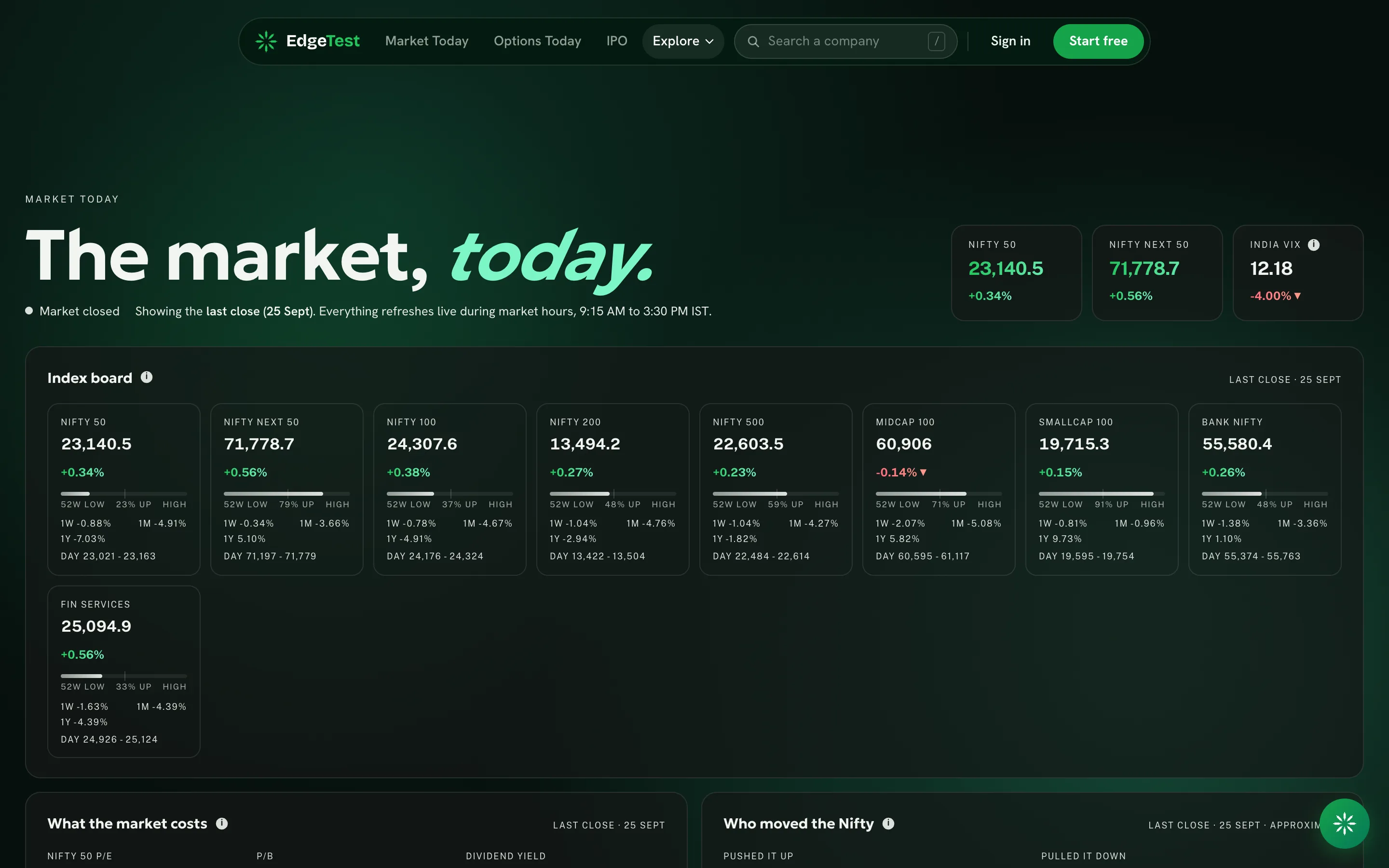
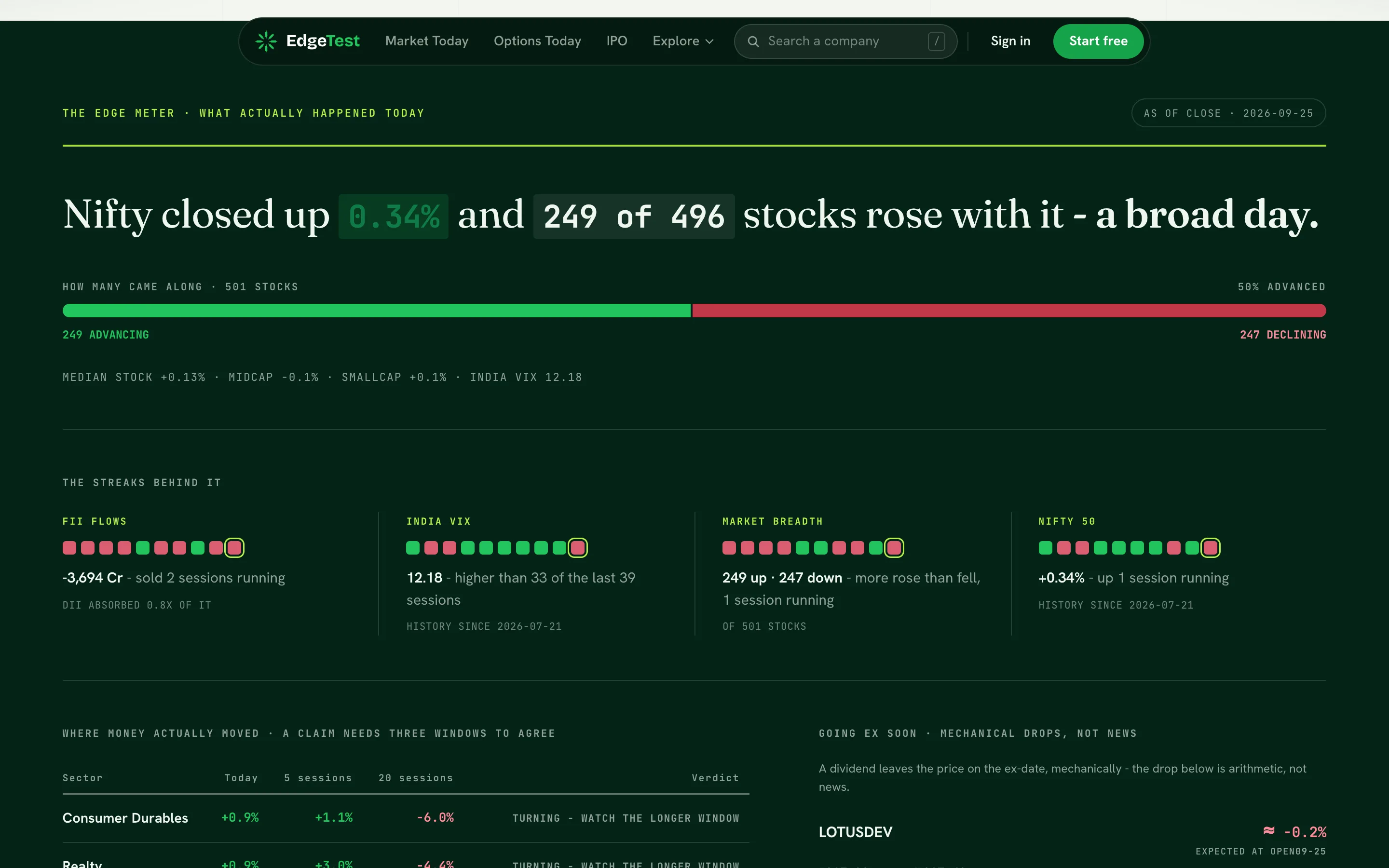
One shared snapshot across workers so no two devices disagree.
- Market Today21 live cards: breadth, VIX, sector P/E, who moved the Nifty, FII/DII gross, delivery-based "bought to hold", streaks.
- Options Today17 cards on 5 indices: max pain, PCR vs its year, OI walls, rollover, skew, straddle decay, probability of profit.
- ~210 F&O stock pages21 cards: implied vs realized vol, balance sheet, cash flow, ownership, sector rank.
What I tested, what survived
Pre-registered in git before data was opened, final period opened once, judged net of measured spreads and statutory costs at 10 NIFTY lots. Most ideas fail; I report that.
My 09:20 short ATM straddle with a per-leg stop: is the entry time the edge?
No257 of 281 entry minutes are profitable. The stop is the strategy, and its best multiple flips: tight wins in choppy 2024, no-stop wins in trending 2025. Sealed 2025: +0.5 bp/day, t 0.56, not significant.
Does a trend-flip system (TrendShift, Pine) work on NIFTY futures, stocks, options, 8 bar sizes?
No intraday~1 bp gross vs 22 bp stock costs; best 2024 setting lost Rs 92K at 10 lots in 2025. On daily bars the timing is real (100th percentile vs shuffles, Sharpe 1.37 vs 1.13, drawdown -23% vs -57%) but it only holds ~54% of the time, so it trails buy-and-hold on return.
Kernel-band Heikin Ashi stop-and-reverse; Optuna S/R breakout on 1-min futures
No0 of 864 stock settings positive; best futures setting Deflated Sharpe 0.35; Optuna winner (Sharpe 2.1 in 2024) lost 1.4 bp/day sealed.
Can I trade the short swings in option premiums (1 to 60 min)?
No72-80% of a 1-min option move is delta times the index; no pattern in swings. One apparent mean-reversion edge vanished when traded as a straddle: it was a hedging artifact.
Last-30-minute index momentum; afternoon option drift (India literature)
No1 to 2 bp of effect against 3 to 90 bp of cost. The US result does not transfer.
Monthly NIFTY put-write, turn-of-month, 200-day filter, PEAD
MixedPut-write earned 5.4%/yr, below cash; March 2020 wiped out 125 months of premium. 200-day trend halves drawdown but costs ~4%/yr: a risk overlay, not a return source. PEAD works pre-cost, not long-only after costs.
Does momentum really earn overnight?
Yes, in cash+9 bp/day, but futures open ~20 bp above the cash auction, so the same premium is -0.9 bp/day in futures. Mostly an opening-auction effect, not harvestable.
Can I predict a big 5 to 10 min move (not its direction)?
YesAUC 0.76 vs 0.50 clock-only on NIFTY futures and spot out of sample, top-decile lift 3.3 to 3.6x, driven by recent range and volatility. A straddle leg-out attempt to monetise it lost, so it is not yet a trade.
Live paper trading since 17 May 2026
Four algorithms paper-traded on a private EdgeTest dashboard with live P&L, itemised charges and a forward record. Signals are logged before outcomes exist and never rewritten.
Equity momentum book
Rs 5L
+Rs 45,703+9.1% since inception
10 holdings; ledger reconciled to the original to the paisa.
Index options, defined-risk
NIFTY, BANKNIFTY, FINNIFTY
+Rs 43,446
over 19 trades, 16 winners (84%); last settled 5 Oct.
Equity swing breakout
Rs 10L
-Rs 57,689
over 2 trades, both stopped out. Low-frequency by design (about 5 signals a year); sample too small to judge.
Intraday index options, short premium
5 lots
+Rs 28,511
over 7 sessions (30 Sep to 9 Oct), all 7 profitable. Too short a record to call an edge.
Paper trading, not live capital. Figures are net of all charges, as of the 9 Oct 2026 close.
Background
Technical Lead, EdgeTest (Imperial Quant LLP), Surat
Jun 2026 to Present
Own architecture, data, engines, infra and delivery. Plain-English strategy in, NSE backtest out. 72-table production database, analysis only, no order routing.
Performance Marketer, Designer & Web Developer, DPG Media, Surat
2024 to Present
63 Meta campaigns for 12+ brands (2.4M+ impressions, 878 leads, best CPL Rs 12 to 16, peak ROAS 14.4x). Built dpgmedia.in solo.
B.Tech, Computer Software Engineering, PDEU, Ahmedabad
Completed 2024
Technical skills
- Quant & trading
- backtest engine design, fill and slippage models, Black-Scholes, implied vol, Greeks, IV rank, SPAN margin, NSE cost stack, expiry and lot regimes, corporate actions, point-in-time fundamentals, look-ahead control, PBO, Deflated Sharpe, shuffle controls
- Stack
- Python (pandas, numpy, numba, pytest), SQL, PostgreSQL, TimescaleDB, Redis, Celery, FastAPI, TypeScript, React, Next.js, Docker, nginx, Linux, Cloudflare, GitHub Actions, Sentry, LLM tool-use APIs
- Practice
- mutation testing, independent re-implementation checks, byte-identical regression before deploys
Let's talk.
Email is the quickest way to reach me. I reply within a day. My resume has the full detail.
Download resume (PDF)